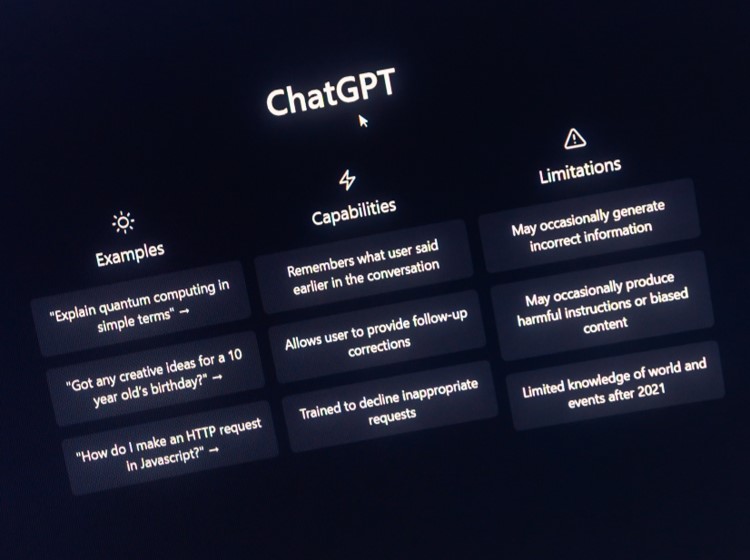
I’m catching up with some friends and inevitably we start talking about technology and ChatGPT comes up. Until now, I’d resisted the urge to delve into the world of ChatGPT, partly because I’ve been too busy and the other being I could get lost in a rabbit hole of wonder and amazement.
Since late 2022 when ChatGPT came on scene, it’s become popular, so much so that I don’t think I’ve gone a few days without hearing about it. Whether in the news, my RSS feed or in my professional network, people are amazed at what ChatGPT can do. There’s also a downside to any innovation and this one isn’t without its risks.
Microsoft has invested heavily into OpenAI and has since integrated ChatGPT into it’s Bing search. With this push, other companies like Google are now accelerating their generative AI development for consumer use. No one wants to be left behind.
So…what is ChatGPT?
ChatGPT is an Artificial Intelligence (AI) driven chatbot, created by OpenAI, that allows you to make requests and it will provide you a response. You tell this generative AI technology what you want and it will craft a response. It does allow you to follow-up and ask to make changes to the provided response as well as challenge it’s accuracy. So, what makes this any different than the Google’s and Bing’s of the world? Simple, artificial intelligence. Unlike today’s search engines, ChatGPT is built with technology that allows it to consume mass amounts of data and learn from that input by way of Machine Learning (ML). It then uses what’s called Natural Language Processing (NLP) to take all that it’s learned and formulate responses in a way that a human would respond (dare I say…naturally).
How can I use ChatGPT?
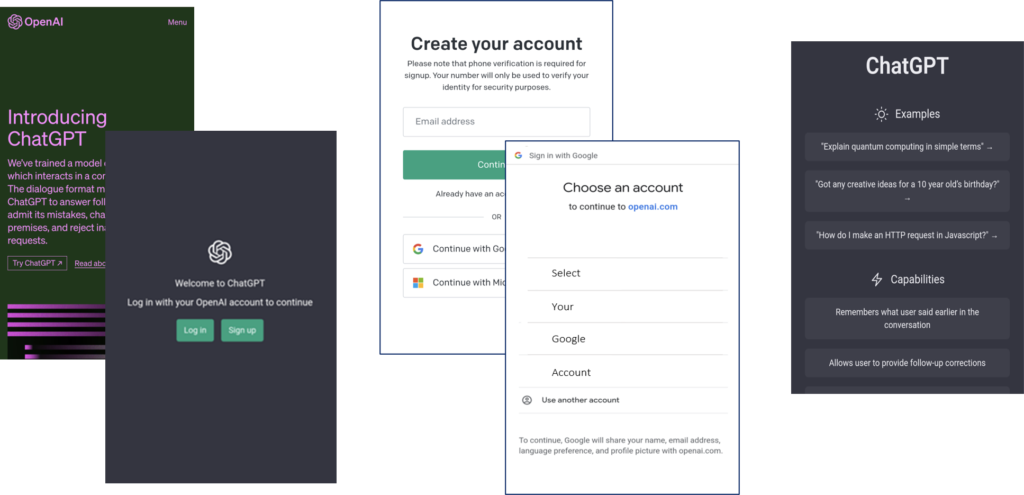
If you’re ready to give it a try, the steps below will get you on your way. You may need to try this from your phone or tablet as my attempts to test via laptop were unsuccessful. Worked fine on mobile but on the laptop, I was lost in an authentication loop.
- Head over to https://openai.com/blog/chatgpt and look for Try ChatGPT
- Alternatively, head straight to https://chat.openai.com/
- You may need to verify that you’re human which shouldn’t be too hard
- I’ve included some additional screenshots to help you along
What can you do with ChatGPT?
First things first, I must caution you about what information you share with ChatGPT. You’ll be freely giving this information to OpenAI which could be used to continue training the AI, but could also be used for other purposes. I recommend not giving away personal information and that you also don’t feed it sensitive work information in an effort to get the job done faster.
The possibilities seem endless with ChatGPT. In my first 60 minutes of testing ChatGPT, the results have been great. Though the second question I asked it, “what can you do?” came back with an error. Maybe it was just bad timing or OpenAI doesn’t want us looking too far under the hood, especially since this is just the testing, feedback phase.
Some use cases that have already been explored, by myself, friends, colleagues and from what I’ve heard in the news include ask it:
- Fact-based questions such who is the current Prime Minister of Canada?
- Create a 30-day workout plan where you can give it specifics on focus areas and workout limits
- Write an article or essay on your topic of choice
- Draft an email showing someone appreciation for a job well done
- Prepare a travel itinerary with historical sites and built in time for travel
- Create code for a web page or ask for excel formula
- Write a cover letter for new role, and including how experience from an old role is relevant
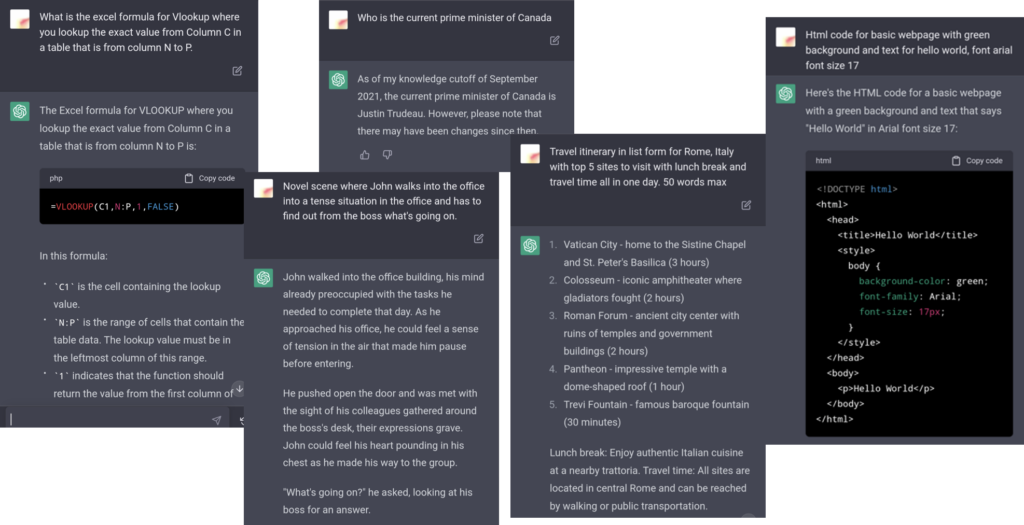
The above are just a few examples that I’ve heard of or tested but it’s worth repeating that the possibilities really do seem limitless.
What’s the downside?
In its current feedback phase, ChatGPT only has access to data points from 2021 and before. Also, the technology is known to provide inaccurate information at times despite how convincing the writing may be. For those who might be wide-eyed thinking school work is now a piece of cake, new technologies have been created to identify AI produced and plagiarized content. And as I said in the beginning, you should care about your privacy and should not give it sensitive information.
Given the current attention this is getting and the race to truly consumerize this technology (just look at Microsoft), it’s not inconceivable that this becomes the norm by the end of 2023. AI has been around for decades and now we’re getting to a point of direct mass consumer interaction, which has a tendency to create mainstream adoption.